
Working Groups and Swarms at CELL
A configuration space at each Working Group

At CELL, we are thinking of how to organize our charter around Working Groups and Swarms.
Caveat: This is a working draft: subject to hard debate, and if it doesn’t hold, propose a better charter.
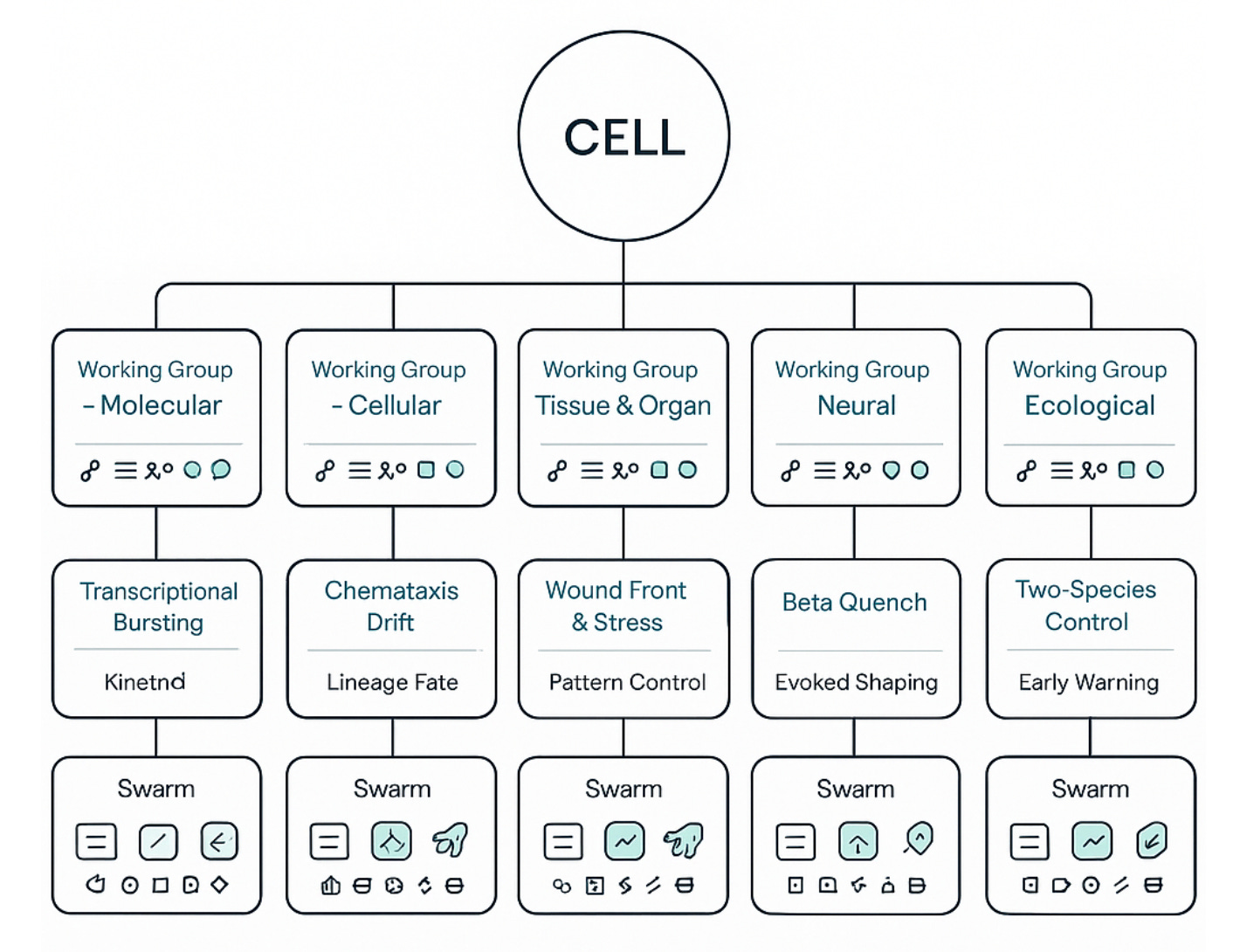
A Working Group anchors one biological scale (molecular, cellular, tissue and organ, neural, or ecological), by maintaining a live mathematical configuration space for that scale: the explicit state to be modeled, a small palette of admissible operators and how they compose, boundary and interface rules, the measurement map and permitted perturbations, an environment vector to report, and a single public score with a fixed diagnostic panel that decides pass or fail.
A Swarm is the project that lives inside the Working Group and moves it forward by taking one sharp question, shipping runnable releases with data, protocol, score, and diagnostics, and earning changes to the configuration space with evidence.
Goals of the charter:
Make results comparable across labs at the same scale through a shared configuration space.
Turn claims into runnable releases with a public score and diagnostic checks.
Let scales connect cleanly by naming interface variables and testing preservation.
Keep physics in the loop with a thermodynamic ledger and invariant tests.
Lower the activation energy for small labs with a micro-kit starter and shared assets.
Evolve the configuration space by evidence, not opinion.
Working Groups by scale
Each Working Group stewards the configuration space at one scale and runs Swarm projects inside it.
Molecular
Scope: reaction networks, gene regulation, near-membrane transport.
Examples of Swarm projects: transcriptional bursting under step and ramp dosing. Kinetic proofreading under ligand titration.
Cellular
Scope: state transitions, motility, contact rules, division and death.
Examples: chemotaxis in a microfluidic gradient. Lineage fate under pulsed induction.
Tissue and organ
Scope: reaction, diffusion, mechanics with real boundaries.
Examples: wound-edge signaling under controlled strain. Pattern control with spatiotemporal dosing.
Neural
Scope: mesoscopic neural fields and networks, closed-loop stimulation with safety.
Examples: quenching beta-band oscillations under latency jitter. Evoked response shaping.
Ecological
Scope: population and community dynamics with intervention under uncertainty.
Examples: two-species control under process noise. Early warning in a shifting environment.
What a Working Group publishes
A minimal, public specification that any lab can use.
Minimal spec
State space: variables, discrete or continuous, dimensionality and bounds, boundary regularity.
Admissible operators: 3–7 per scale, unit consistent, invariant preserving, plus an explicit out-of-scope list.
Boundaries and interfaces: which surfaces or compartments matter and the rule at each.
Environment vector: first-class parameters to vary and report, for example temperature, viscosity, substrate stiffness, media.
Thermodynamic ledger: mass, charge, energy, free-energy accounting with unit checks.
Score: one public scalar that gates pass or fail, paired with a fixed diagnostic panel.
External validity slice: one withheld or shifted condition.
Governance
Cross-WG red-team on every new spec.
Evidence moves specs: changes must cite a scorer result or a failed diagnostic.
Minority reports attach to releases. Forks are allowed when evidence supports an alternate spec.
What a Swarm is
A Swarm is a project inside a Working Group. It can span months, carry a roadmap, and contain sprints. Each phase ends in a release.
Release contents
Small dataset and a one-page protocol.
The public score and a fixed diagnostic panel.
A reference run within a declared compute envelope.
Release types
Verification releases: target a known effect with a precise pass band.
Discovery releases: score calibrated novelty and robustness, and record negative results.
Diagnostics pattern
Calibration or coverage check.
Invariant and ledger checks.
Rank-stability note across one alternate metric.
Fail-closed rule: if any diagnostic fails, the claim does not clear.
Thresholds come from a short inter-lab pilot and are versioned with the kit.
Compute fairness
Two envelopes share the same score and diagnostics.
Reference envelope: modest CPU or single GPU with stated wall-time and memory caps.
Research envelope: no cap, with results also reported on a proxy task that fits the reference envelope.
Cross-scale and timescales
Named interface variables in and out, plus a preservation test tied to the score.
Timescale audit: if fast and slow processes are not well separated, include an explicit memory term or restrict the claim.
Ledger practicality
Ledger tiers:
L0 units and stoichiometry.
L1 energy bounds using literature priors.
L2 detailed budgets.
Default is L1. L2 is required only when the question hinges on energetics.
On-ramp
Micro-kit starter: one page spec, one dataset slice, one score, one diagnostic panel, one reference run.
Shared assets: central calibration files, environment recipes, and example scripts.
The shared goal of all Swarm projects
Swarms exist to move the Working Group’s configuration space forward at that scale.
Accepted contributions include:
Tighten the state space: clarify variables, domains, bounds, regularity, or mixed discrete–continuous partitions.
Improve the operator palette: add, remove, or constrain operators with unit checks and invariants, and specify composition and interface rules.
Specify boundaries and interfaces: propose enforceable boundary rules and cross-scale interface variables with preservation tests.
Sharpen the environment vector: define first-class context variables, admissible ranges, and external-validity slices.
Update the thermodynamic ledger: add budgets, priors, calculators, and failing examples that become unit tests.
Refine the public score and diagnostics: justify the primary scalar, add calibration or coverage checks, and provide rank-stability evidence.
Ship shared assets: calibration files, reference runs, proxy tasks, and minimal datasets.
Acceptance gates for a Swarm release to change the spec
The release passes the WG’s score and all diagnostics on public and withheld conditions.
The proposed spec delta is written in one paragraph with a clear before to after diff.
Evidence reproduces on the reference compute envelope.
Backward compatibility is noted or a deprecation path is included.
Version bump with changelog and provenance.
Two compact examples
Molecular WG example
Goal: estimate burst size and burst frequency from a reporter line under step and ramp dosing, then show the model reproduces the observed single-cell count histograms over time.
What you run:
Data: single-cell time series plus a short two-pulse schedule that stays hidden until evaluation.
Score to pass: the model’s predicted histograms match the measured histograms across time within a single threshold X (think “average mismatch across all time points”). We will show a one-line number and a green pass or red fail.
Checks you must include:
Calibration plots: predicted vs observed fractions per count bin over time.
Sanity checks: no negative counts, bleaching within the stated limit, dose timestamps match the protocol.
Robustness check: when we recompute the mismatch with a second reasonable method, the ranking of methods does not flip.
Runtime: finishes on a normal workstation in about 2 hours.
External validity: after you tune on step and ramp, you must also match the hidden two-pulse schedule within the same threshold.
Spec contributions likely from this kit: upload the probe calibration file, add the maturation-lag correction rule, and record the dose-timing window you actually used.
Cellular WG example
Goal: from tracked paths in a microfluidic gradient, recover the chemotactic drift field and report uncertainty.
What you run:
Data: videos with tracks and confidence scores across three gradient strengths and two viscosities.
Score to pass: the average angular error between your inferred drift field and the held-out reference field is ≤ Y degrees, and your uncertainty is calibrated.
Checks you must include:
First-passage plots: time to hit target regions compared with data.
Contact rule sanity: no wall penetration, no overlaps at high density.
Robustness check: using a second reasonable comparison, method rankings do not flip.
Runtime: finishes on a laptop in about 1 hour.
Cross-scale option: you may import a prior magnitude for drift from molecular receptor kinetics. If you do, show a simple preservation test that the molecular summary you imported still holds in this dataset.
Spec contributions likely from this kit: tighten the high-density contact rule and add viscosity ranges to the environment section.
Join CELL us as Member Lab or Member
Member Labs, start here
Pick your scale and help rationalize the Working Group spec.
Propose one Swarm project with a micro-kit starter: one page spec, one dataset slice, one public score, one diagnostic panel, one reference run.
Ship your first release inside the reference compute envelope. Include one external validity slice and the environment vector you used.
What you bring: a question, data, and a credible path to a runnable release.
What you get: shared calibration assets, spec editorial support, and a public place to publish evidence that moves the configuration space.
Members, contribute immediately
Write a scorer or a diagnostic check for an existing kit.
Contribute a calibration file, a boundary test, or a ledger calculator.
Help run the cross-WG red-team for a new spec.
Replicate a reference run on the envelope and file a short report.
Ready to participate?
Choose a scale, pick a Swarm template, and send a one paragraph intent: the question, the primary score, the data slice you can share, and your reference compute envelope. We will route you to the Working Group lead, align on the micro-kit, and get your first release into the queue.
Please send us your proposal at science+collaborate@cellbiosf.org
Subscribe: https://cellbiosf.substack.com
Follow: https://x.com/cellbiosf