
What are Mathematical Organisms?
Consortium for the Equations of Life and Living Systems

I start from a simple claim. Every cell, tissue, and ecosystem is already an equation playing out in real time. A hummingbird’s chest rises and falls while oxygen flux obeys the same conservation law an electrical engineer checks in a breadboard circuit. In a zebrafish embryo, pigment cells glide, then suddenly halt when diffusion and reaction rates hit the threshold Alan Turing penciled into his notebook. I have stared down a lone bacterial flagellum and watched its apparently random flicks trace a master equation borrowed from quantum optics. Moments like these feel like breadcrumbs, pointing toward an algebra that binds the tree of life. I want that algebra on paper.
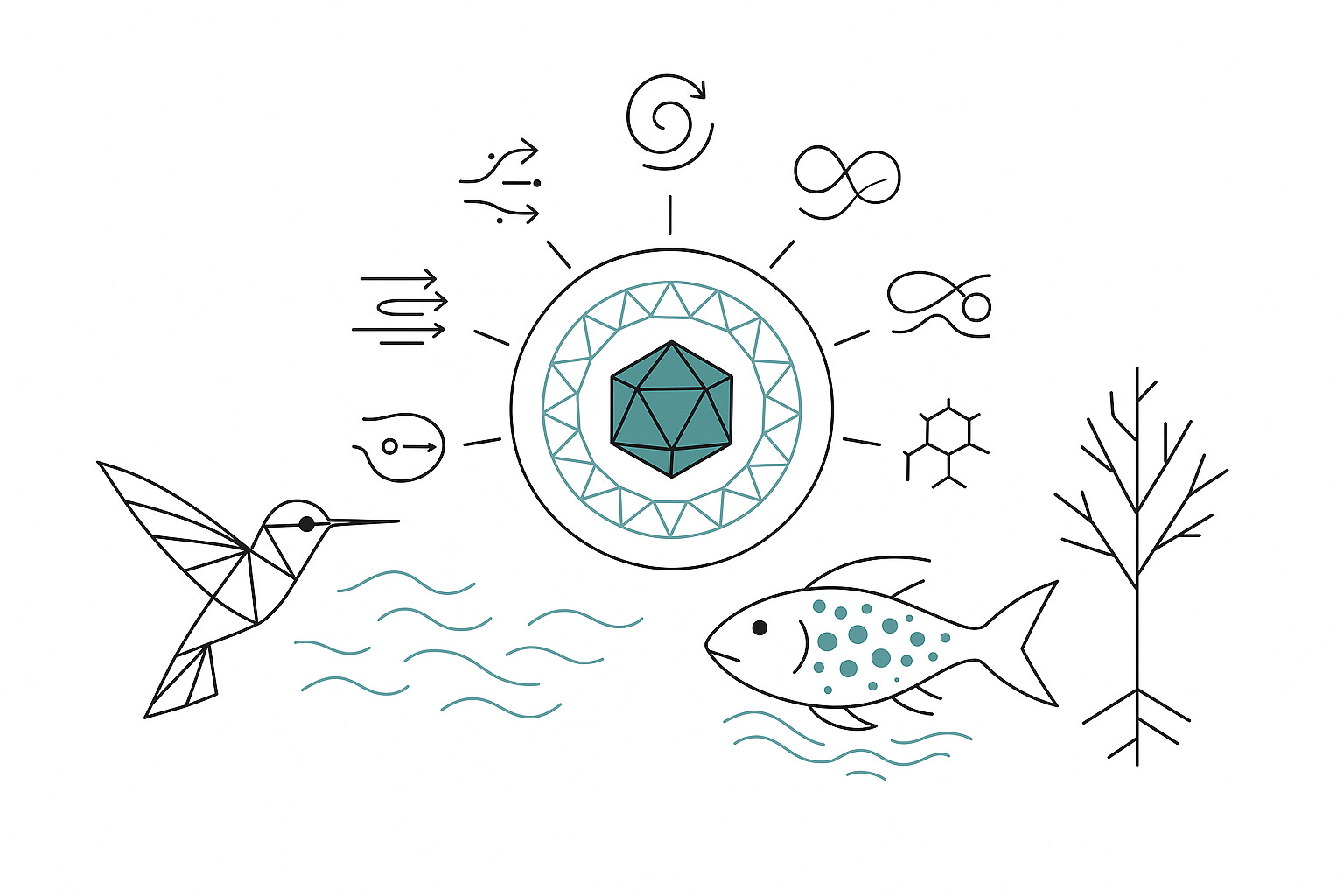
My working hypothesis is direct. Any organism fits inside a mathematical category stocked with a finite library of operators. By composing those operators we can possibly generate every legitimate phenotype, from viral self-assembly to redwood succession. Field measurements, bench assays, and time-lapse imaging tune parameters, yet the operators themselves stay put, much the way Maxwell’s equations remain constant under new circuits. Eight plausible operator families show up in dataset after dataset, each guarding an invariant that biology has yet to break.
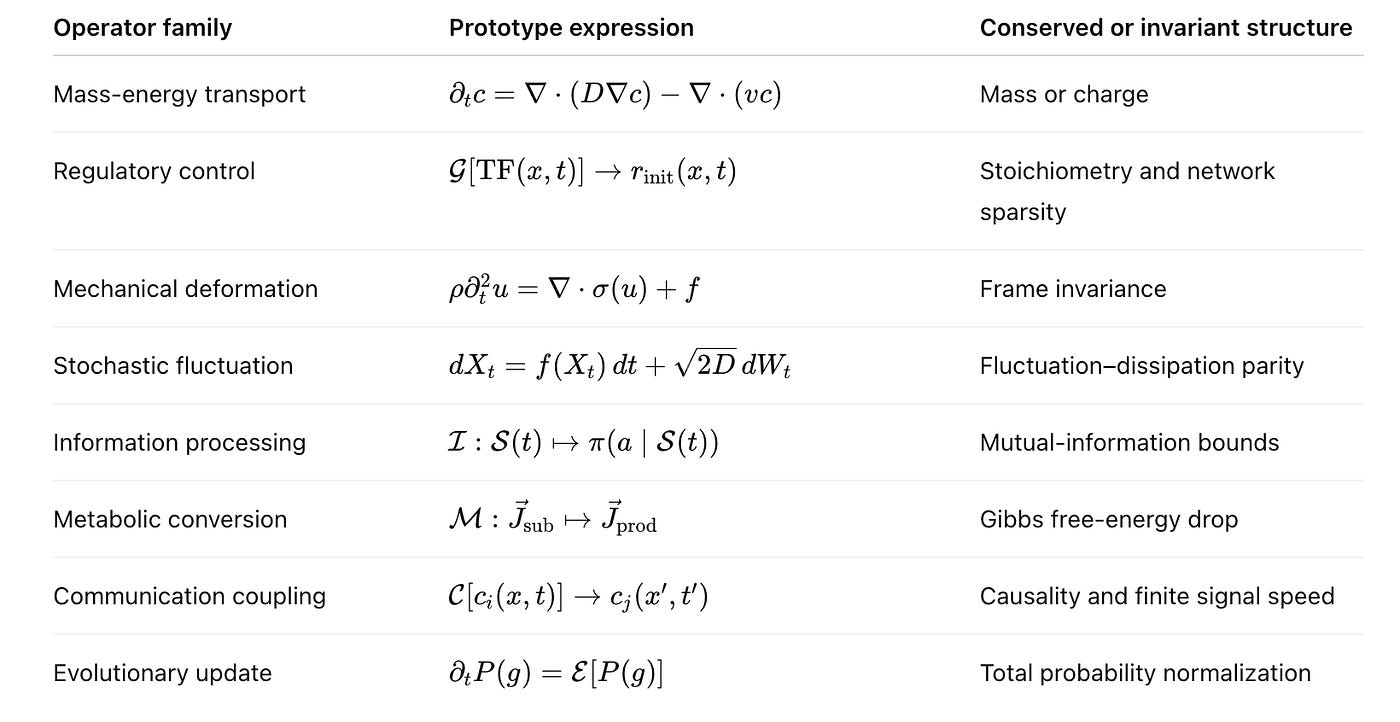
The list holds for now, pencil ready for revisions. After each line we unpack the symbols, explain the invariant, and check it against fresh data before claiming victory.
A first proving ground could be T-cell fate choice. Picture the cytoplasm as a tetrahedral mesh and the nucleus as a tight triangular shell. A coupled system of ordinary differential equations would keep track of cytokine binding, JAK–STAT phosphorylation, and chromatin remodeling. A learned operator Gθ could map spatial STAT5 fields onto transcription-initiation rates after training on perturb-seq slices. Chemical Langevin noise would respect molecular discreteness, while adjoint sensitivities feeding Hamiltonian Monte Carlo would chart the posterior landscape of every rate constant. If such a simulation predicted Th1 versus Th2 outcomes more precisely than rival approaches, the eight families would gain credibility. If it failed, the algebra would learn from the failure.
Next comes mapping operator parameters from bacteria to redwoods, searching for low-dimensional ridges common to all life. Then folding thousands of microscopic rates into a handful of scale-free groups through biological renormalization. After that, streaming lattice light-sheet movies straight into the operator stack so digital twins evolve alongside living cells. Finally, crafting feedback controllers that steer trajectories through phenotype space while paying every energy-information debt.
If you think in categories, solve inverse problems before the coffee cools, or sense a symmetry a moment before the microscope confirms it, this frontier is yours. Let us write the equations of life together, line by precise line, until the math stands on its own and biology gains the predictive power physics has enjoyed for a century.
Something Exciting is Brewing
I’m forming the Consortium for the Equations of Life and Living Systems (CELL) and looking for leading experts in mathematical biology, biophysics, and computational biology to join the collective.

We reject guesswork. Biology now needs a rigorous mathematical core, one that converts observation into prediction and gives the field the quantitative rigor physics reached a hundred years ago.
I’ll release the full blueprint soon. For now, know that our work will be built on five core pillars:
Seal of Rigor: only proofs that withstand scrutiny earn this mark
Model Commons: operators and datasets stay open and shared
Public Benchmarks: fixed reference tasks provide hard comparison points
Validation Arena: models face live data in real time
Talent Engine: researchers learn to move easily between category theory and cryo-EM
If you raise standards, build solvers, or spot symmetries before the data even appears, reach out and help grow the consortium.
Please follow us here for further announcements and logistics: https://x.com/CellBioSF
Innovative perspective. I hear you. However, the AI-generated images ( including those in cognit.ai/) are amateurish and disservice your intended purpose.
A closer look at what you wrote in cognit.ai/ reveals a disconnect between what your titles seem to convey and what you really have to offer. But, perhaps I am not privee to information you are privee to. Wish you all the best for sure.