
The Early Mover’s Protocol
An invitation to set standards, publish the audit trail, and make verification cheap.

Day zero is when the idea is still a draft and the room is quiet. The people who join then are the ones who will take a real bet. Not on personalities. But on Science. On procedures that can be inspected and improved in public. They ask what will be measured, what will be conserved, and how disagreement will be handled. They want to see how a claim could fail, and what happens next if it does.
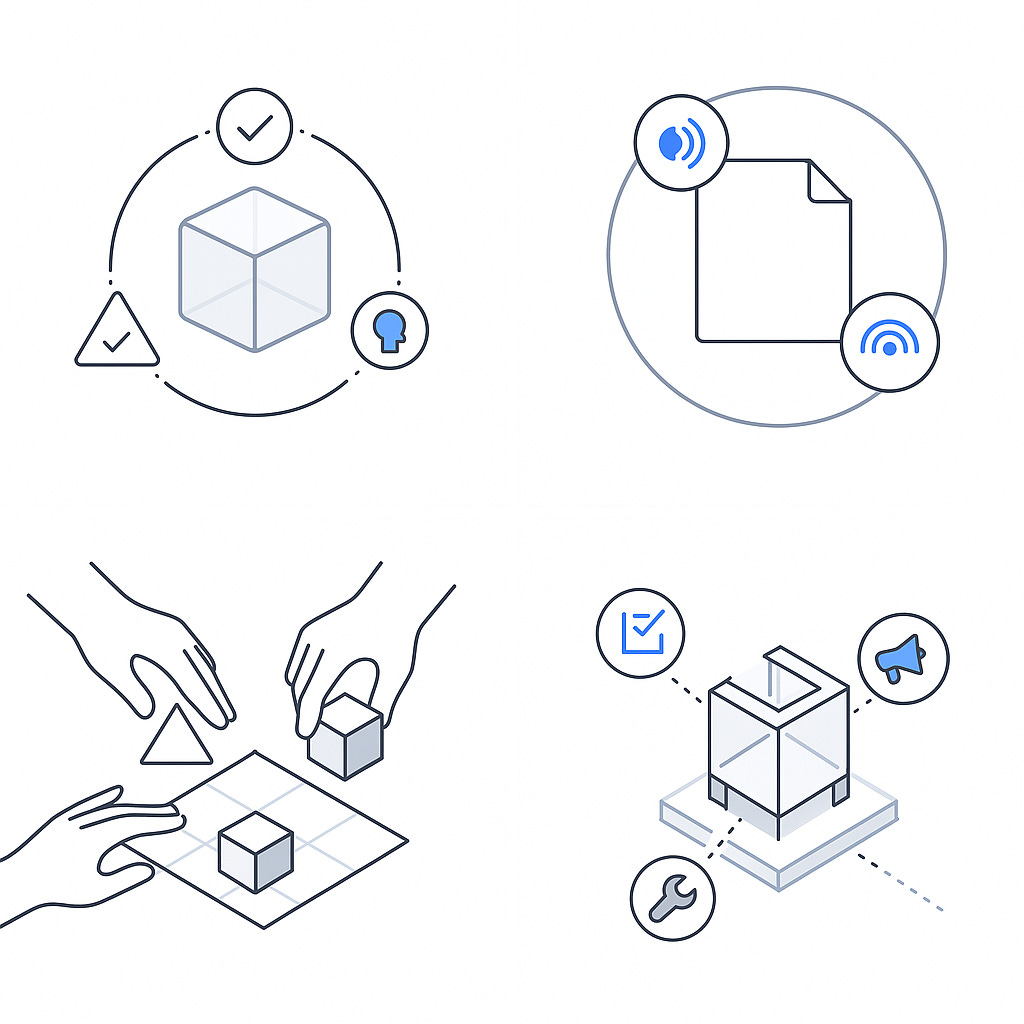
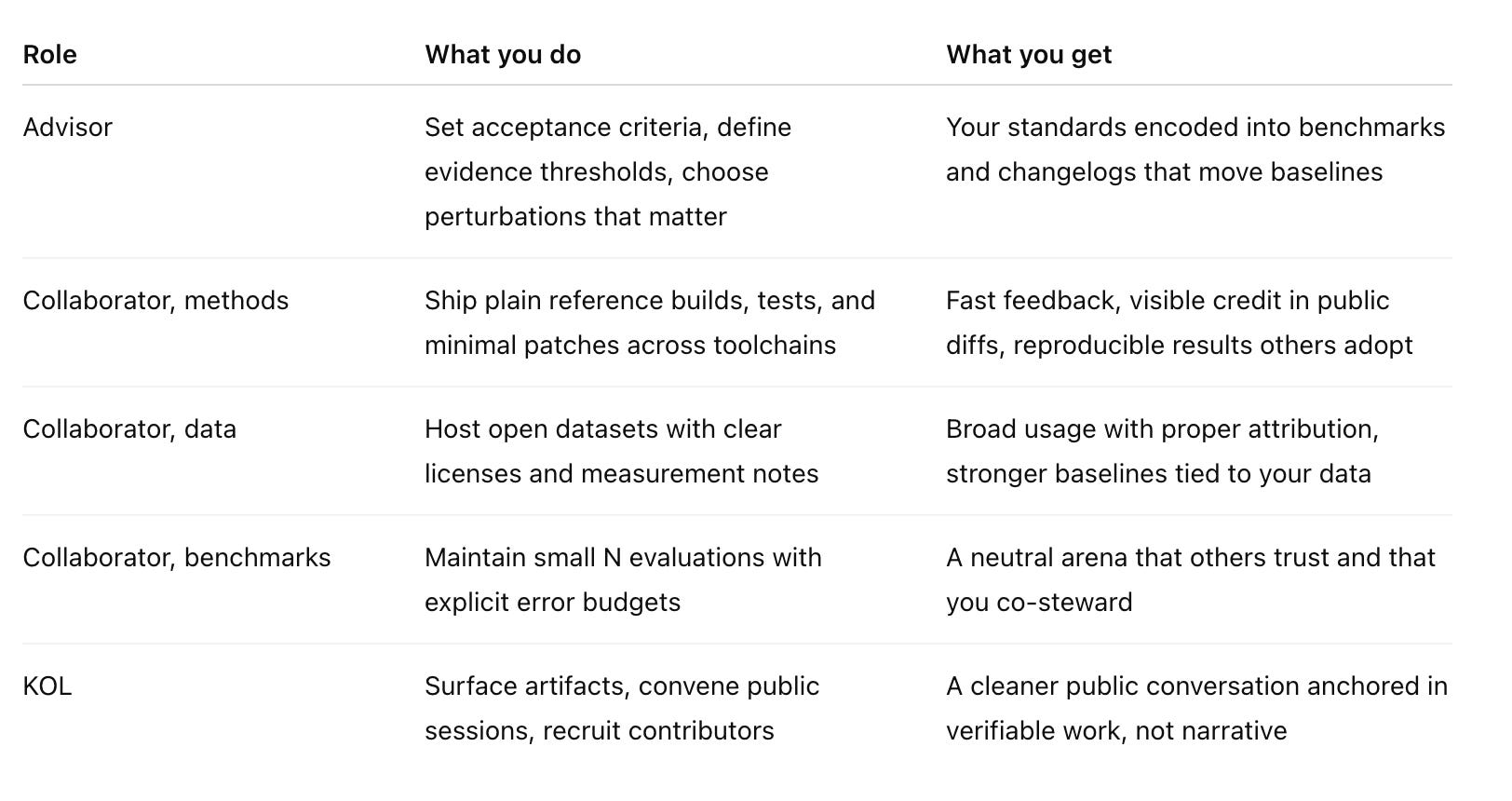
Advisors at day zero shape what counts. They set acceptance criteria. They define what evidence changes a baseline. They specify perturbations that matter and watch methods degrade where they should. They remove complexity that only buys optics. They protect the global rate of learning by keeping progress testable and cheap to verify.
Collaborators at day zero make it real. They wire the intake spec, publish plain reference builds, and keep the replication kit small. They port methods across toolchains, add tests that fail for the right reasons, and maintain a failure catalogue others can extend. They run public jobs on open datasets and record exact conditions so a neutral third party can repeat the run without favors. They file clear issues, propose minimal patches, and document the path from idea to outcome so newcomers do not pay the same tuition.
KOLs at day zero bring reach without theater. They show the work, not the sizzle. They host public whiteboards where counterexamples get priority. They recruit the next wave of contributors by pointing to artifacts that anyone can run. They help align incentives around verification rather than narrative.
Integrity here is operational. Conflicts are declared. A public changelog records reversals as plainly as improvements. Claims are separated from hypotheses, and the hypotheses are versioned. Evaluation criteria are pre-registered when that brings clarity. Undocumented assumptions are treated as defects and fixed in daylight.
What day zero offers is leverage without politics. Standards you help define become living infrastructure. The validation arena prioritizes counterexamples. Reference builds are plain by design, so the path from idea to outcome is visible. Open licenses permit honest recombination. Reproducible builds keep results tied to process rather than personality.
What you bring is discipline where it matters. Domain-specific datasets and perturbations that force contact with reality. A clean definition of success that does not collapse into vibes. Pressure tests for methods you value, run under constraints that reflect the world we actually work in. Decisions about where to tighten standards and where to relax them so learning stays fast without inviting misuse.
No prestige games. No private leaderboards. No pay to play authorship. If something fails, we record it. If something works, we make it cheap to check and cheap to build on. If day zero is where you are most useful, the table is open.
Broad roles at day zero, at a glance:
People who are charitable and believe in doing the science for science’s sake are already here on day zero! We have Dr. Surya Ganguli, and Dr Timothy Nguyen onboard and some amazing people in the pipeline.
Open Call
Day zero at CELL is open to advisors, collaborators, and KOLs who bet on procedures in public. If you care about evidence that moves baselines, join us. Advisors: set acceptance criteria and evidence thresholds. Collaborators: ship plain reference builds, small N benchmarks, minimal replication kits, and a failure catalogue. KOLs: surface artifacts, host open whiteboards, recruit the next wave. Non-executive, remote, public artifacts only. Make trust optional.
subscribe: https://cellbiosf.substack.com
join channel: https://x.com/cellbiosf
It's going to be hard to collaborate with CELL, when joining CELL channel means one has to pay some money (for verification)!