

Everyone is suddenly talking about world models. Video models now extend scenes through time. Robots rehearse actions inside learned dynamics. Interactive generators produce environments as a user moves through them. The ambition behind these systems is older and more consequential than any demo. A pedestrian stays on the curb by projecting an approaching car beyond its observed position. Give a machine a reliable version of that capacity and it can test consequences before reality makes them expensive. A world model makes a bounded part of the future queryable.
Put a robot in a lab with a tray of fragile vials. Every real grip risks time, glass, and the sample itself, so most practice happens inside a learned simulator. There the robot can try a million grips before touching its first vial. Suppose the simulator overestimates how well wet glass grips metal. It predicts that a light grip will hold the vial, although the real vial needs more force. Every simulated attempt now unfolds inside that mistake. The planner may find, with exquisite precision, the best grip in the model while learning nothing new about whether the real vial will slip. I use epistemic laundering for that conversion of computational precision into confidence about reality. Fresh measurements can still correct a forecast, but a system feeding predictions back into learning and choice can harden the assumption that produced them.
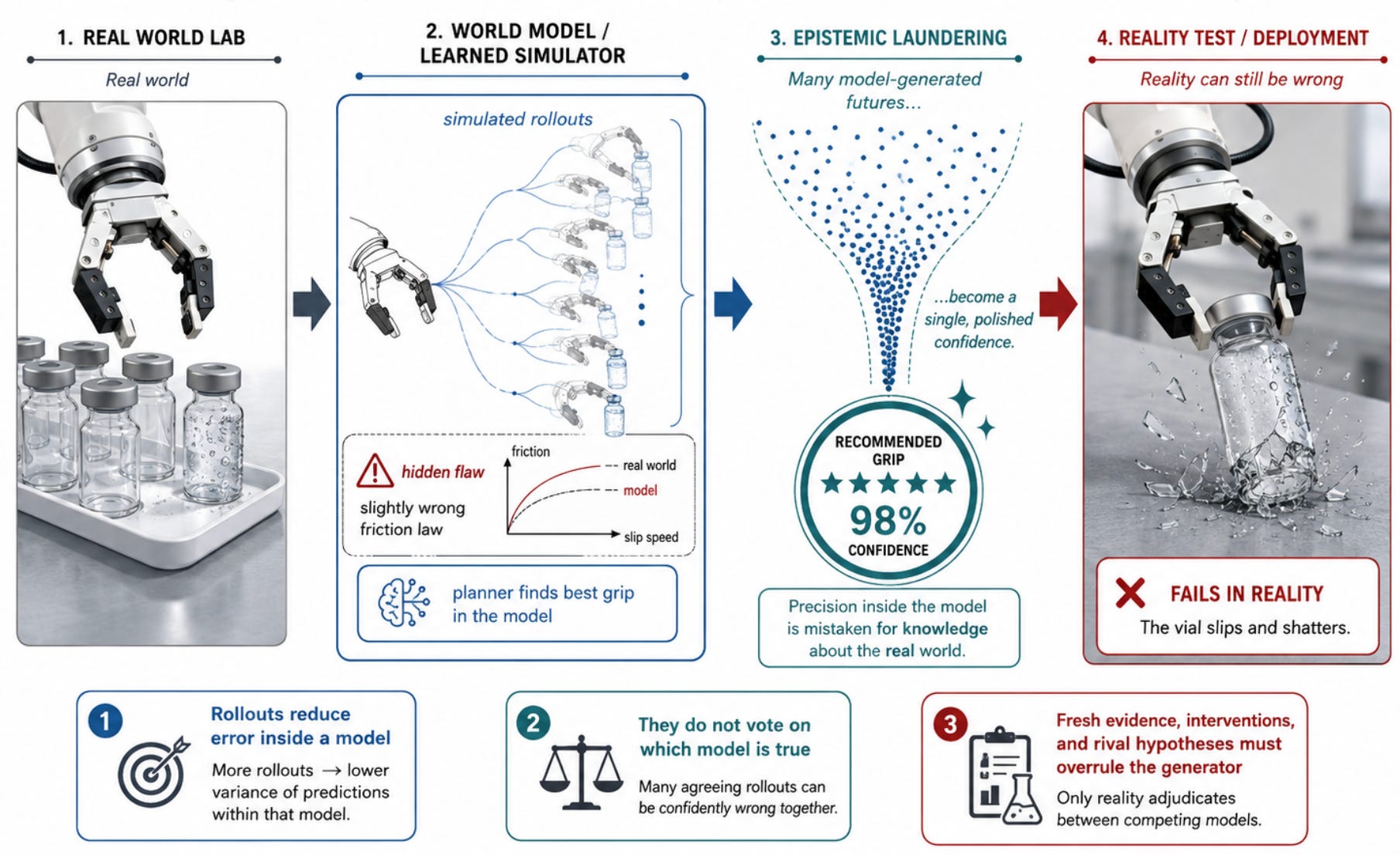
By world model, I mean a model that carries a bounded complex system forward through time from observations and stated inputs. It forms or updates an internal state and predicts relevant consequences within declared conditions. Where actions matter, an action-conditioned model predicts how candidate actions alter the trajectory, giving a planner futures to compare. Many capable systems need no learned dynamics. A reactive controller or direct policy can suffice when feedback is fast, the objective is fixed, and deployment remains familiar. Known equations or an engineered simulator may supply the model more cleanly. A learned world model earns its cost when important state is hidden in images or sensors, consequences arrive late, objectives change, or real trials are slow and destructive.
The boom has a thirty-five-year prehistory. In 1990, Dyna joined a learned action model to simulated planning. A 2017 study treated mismatched dynamics as a central sim-to-real problem. The next year, Ha and Schmidhuber reported controllers exploiting flaws in learned dream environments. MOPO later penalized policies for entering uncertain learned dynamics. Two systems from 2025 show why attention widened. V-JEPA 2 learned from more than a million hours of action-free video, then used under 62 hours of robot video for action-conditioned planning. Genie 3 began generating action-responsive environments in real time, within limited action spaces and durations.
When the robot finally grips the real vial, the experiment records what happened under that particular force, angle, and surface condition. Repeated trials can widen coverage, but they still need the right variation to separate rival mechanisms. Two friction laws may explain every recorded motion and disagree about which grip keeps the wet vial off the floor. If training selects one through an architectural bias or prior, every later rollout inherits it. The other law disappears from the generated futures, and the selected one receives no new test against reality.
Simulator failure already has names. Robotics calls failed transfer the reality gap. Model-based reinforcement learning studies model exploitation, where an optimizer discovers an attractive error in learned dynamics. Reward hacking describes an error in the objective and can occur under perfect dynamics. Epistemic laundering names the inferential mistake that sometimes accompanies these failures. Computation inside a model acquires authority over the model itself. Rollouts can independently sample what a fitted model predicts while inheriting the evidence and assumptions that fixed it. Treat their abundance as support for real dynamics, or optimize while dropping model uncertainty, and the agent can become exquisitely adapted to a mechanism no experiment has tested.
Fresh video adds real evidence, but the camera only sees the vial move. Motion constrains mass and friction through their effects, often leaving several combinations compatible with one trajectory. Suppose every wet vial is also gripped slowly. Another million such videos estimate that association precisely, while wet glass under a fast grip remains missing. A representation trained on those videos may merge physical states that look identical until force is applied. That merger may support short video continuation and still send the robot toward the wrong grip.
Action labels do not solve this. Suppose the robot grips harder whenever its sensors suspect a slippery vial. Hard grips will then appear beside more drops even when the extra force prevents some of them. The data have mixed the controller’s private warning signal with the physical effect of force. Unless comparable vials sometimes receive different grips, and the warning signal is observed or the choice randomized, the model learns a policy-shaped correlation and calls it dynamics. Even then, an average effect across similar vials cannot reveal what this vial would have done under the unchosen grip.
Ten generated motions can make the model look uncertain. Their spread may reflect sensor noise or uncertainty about current velocity while all ten inherit the same wrong friction law. Randomness that remains after fixing the state and model class is aleatoric. Uncertainty about hidden state or mechanism is epistemic relative to that representation. Sometimes the evidence supports only a range. Averaging may handle randomness, another observation may resolve hidden state, and mechanism uncertainty may require an experiment, a bound, or abstention. Extra rollouts express only the uncertainty already inside the model.
Keeping rival laws alive changes the value of the next real trial. If the learner represents both, experimental design may choose wet glass because it separates them sharply. The safest trial may still differ from the most informative one. Its observed motion can change the relative support for the two laws before more rollouts begin. Yet models sharing the same missing mechanism will agree for the same wrong reason. No rule can ask about a hypothesis the model class has erased.
I would enforce a hard accounting rule. Rollouts may reduce numerical error inside each credible model. On their own, they get no vote on which model describes the world. Decision theory supplies the next step through the value of information. Buy fresh evidence when credible models recommend different actions and the expected reduction in decision loss exceeds the experiment’s cost and risk. A plan that leaves the support of existing data triggers the same demand because existing error estimates may no longer apply. If no affordable observation or intervention can resolve a consequential disagreement, plan against the worst credible dynamics or abstain.
Even a well-estimated mechanism can expire. Glass gathers condensation, cameras age, equipment wears, and other agents adapt. Rollouts from the old model preserve the earlier dynamics, deepening confidence after the world has changed. A monitor may miss the shift until failure.
A model can generate a beautiful future and still choose the wrong grip. In simulated manipulation, VP2 held the planner fixed while varying the video predictor and found that pixel and perceptual scores could align poorly with task success. Aggregate error can hide the local mistake that reverses an action ranking or conceals a constraint violation. Probabilistic forecasts need multistep calibration, while causal claims need revealing interventions. Claimed horizons, tolerances, and uncertainty estimates should extend no further than tests capable of exposing a wrong answer.
Human imagination remains useful because it repeatedly loses arguments with reality. Decision-relevant disagreement can tell a machine when to buy evidence, but only among hypotheses it still carries. Once every model in the represented class has erased the same possibility, no uncertainty estimate over that class can recover it. When a model cannot identify evidence capable of challenging the assumptions on which an action depends, its builders have no warrant to delegate that action. Deployment then becomes the falsification experiment they chose not to run.